


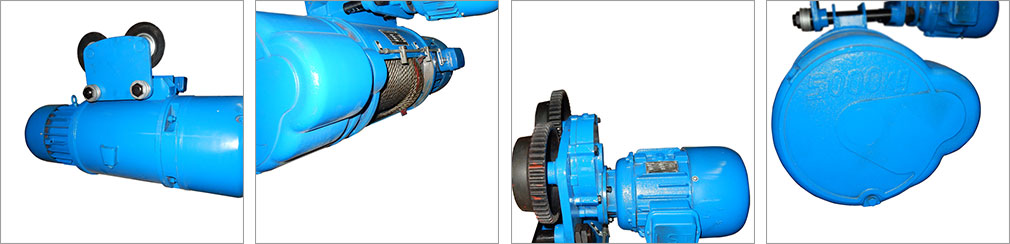
▶ Product Introduction
● CD1、MD1 Compact structure, light weight, small size, and convenient operation;
● It can be installed separately on overhead l-beams or used in conjunction with electric or manual single beams, double beams, suspension beams, gantry cranes, etc;
● Carefully make every component and diligently pursue quality;
●The group's procurement of refined components, excellent processes to reduce costs, and best-selling both domestically and internationally.
▶ Technical Parameters
| Model | CD1 0.5T | CD1 1T | CD1 2T | CD1 3T | CD1 5T | CD1 10T | MD1、CD1 16T | ||||||||||||||
| Capacity(T) | 0.5 | 1 | 2 | 3 | 5 | 10 | 16 | ||||||||||||||
| Lifting Height(m) | 6 | 9 | 6 | 9 | 12 | 6 | 9 | 1 | 6 | 9 | 12 | 6 | 9 | 12 | 6 | 9 | 12 | 6 | 9 | 12 | |
| 12 | 18 | 18 | 24 | 30 | 18 | 24 | 3 0 | 18 | 1 | 30 | 18 | 14 | 30 | 2 | 30 | 2 | 3 | ||||
| 0 | 4 | 4 | 4 | 0 | |||||||||||||||||
| Travel ing Speed(m/min) | 20(30) | 20(30) | 20(30) | 20(30) | 20(30) | 20(30) | 20(30) | ||||||||||||||
| Lifting Sead(m/min) | 8 8/0.8 | 8 8/0.8 | 8 8/0.8 | 8 8/0.8 | 8 8/0.8 | 7 7/0.7 | 3.5 0.35/35 | ||||||||||||||
| Wire Rope Type | 6X37+NF | 6X37+NF | 6X37+NF | 6X37+NF | 6X37+NF | 6X29Fi+FC | 6X29Fi+FC | ||||||||||||||
| I-STEEL Bean Tack | 16–28b | 16–28b | 20a–32c | 20a–32c | 25a–63c | 28a–63c | 36a–63c | ||||||||||||||
| Circular orbit minimum radius | 1–1.2 | 1–3.3 | 1.2–3.5 | 1.2–3.5 | 1.5-4 | 2.5–7.2 | 3.5–9 | ||||||||||||||
| Lifting Motor | Model | ZD1 21–4 ZDS1-0.2/1 | ZD1 22–4 ZDS1-0.2/1.5 | ZD1 31–4 ZDS1-0.4/3 | ZD1 41–4 ZDS1-0.4/4.5 | ZD1 41–4 ZDS1-0.8/7.5 | ZD1 51–4 ZDS11.5/13 | ZD1 51–4 ZDS1-1.5/13 | |||||||||||||
| Capacity kw | 0.8 | 1.5 | 3.0 | 4.5 | 7.5 | 13 | 13 | ||||||||||||||
| R.P.M R/min | 1380 | 1380 | 1380 | 1380 | 1380 | 1380 | 1380 | ||||||||||||||
| Power 3P | 380V 50HZ | 380V 50HZ | 380V 50HZ | 380V 50HZ | 380V 50HZ | 380V 50HZ | 380V 50HZ | ||||||||||||||
| Traverstring | Model | ZDY1 11–4 | ZDY1 11–4 | ZDY1 12–4 | ZDY1 12–4 | ZDY1 21–4 | ZDY1 11–4 | ZDY1 11–4 | |||||||||||||
| Capacit kw | 0.2 | 0.2 | 0.4 | 0.4 | 0.8 | 0.8X2 | 0.8X2 | ||||||||||||||
| R.P.M R/min | 1380 | 1380 | 1380 | 1380 | 1380 | 1380 | 1380 | ||||||||||||||
| Power 3P | 380V 50HZ | 380V 50HZ | 380V 50HZ | 380V 50HZ | 380V 50HZ | 380V 50HZ | 380V 50HZ | ||||||||||||||
▶ Company Introduction
Baoding Hoisting Machinery Works ,founded in1976,covers an area of 25000 square,owning more than 180 employees,lt is located in the ancient city of Baoding,which is close to the highway,107 national road and other important traffic trunklines.The convenient transportation and flow of information make us have the unique geographical advantage.Our factory has rich production experience, advanced production equipment, and perfect means.

▶ Our Products
Our main products are "golden dragon" brand HS, HSZ-A, HSZ-B, HSZ-C, HSZ-D, HSZ-E, HSZ-VD, HSZ-VT, HSZ-O, and roller shutter series Chain Block.At the same time,we also produce HSH-E and HSH-VT series lever hoists; PA.CD1.MD1.JC25 and HHBB series electric hoists; GCT and DST series plain trolley; hand hydraulic car; Electric Winch; cargo trolley; Magnetic lifter; Mechanical Jack; webbing slings etc.
▶ Qualifications Possessed
Our chain blocks have passed the CE certficate GS certificate and ISO9001 international quality system certificate since 20o1.For their reliable performance and excellent quality,our commodities have been exported to more than 30 countries in the world,and earn good reputation both at home and abroad.

At present,our annual production capacity is 150000 units _and more than 95% of them are exported abroad.Providing first-class products and thoughtful after- sales service are our consistence purpose.Sincerely welcome you to establish business relations with us,and seek common development!
CD1. MD1.Series Electric Wire Rope Hoist: A Practical Choice for Industrial Lifting
Do you need to lift machinery, production parts, or heavy materials without relying on repeated manual handling? In many factories and workshops, lifting is part of the daily job, but choosing the wrong hoist can make the work slower and harder. From our experience in manufacturing lifting equipment, we know that the right hoist should match the load, working environment, installation method, and actual lifting task.
The CD1. MD1.Series Electric Wire Rope Hoist is designed as a powered lifting solution for industrial material handling. It uses electric power and wire rope to raise and lower suitable loads, helping operators reduce physical effort and handle materials in a more controlled way.
At Baoding Hoisting Machinery Works, we have been producing lifting equipment since 1976. Our factory covers about 25,000 square meters and has more than 180 employees. With long-term manufacturing experience, production equipment, and testing facilities, we focus on practical lifting equipment for factories, workshops, warehouses, and other working environments.
The CD1. MD1.Series Electric Wire Rope Hoist is an electrically powered lifting machine that uses wire rope to move suitable loads vertically. Compared with manually operated lifting equipment, an electric hoist can reduce the physical work required from operators and make repeated lifting tasks more convenient.
In practical use, the hoist can be incorporated into a suitable lifting system according to the installation and load requirements. Depending on the actual equipment arrangement, lifting equipment may work with supporting structures, trolleys, beams, or other compatible components.
One important point is that an electric wire rope hoist should not simply be selected by looking at the product name. The working load, lifting direction, installation structure, frequency of use, and surrounding environment all matter.
ASME HST-4 describes electric wire rope hoists in the context of vertical lifting of freely suspended, unguided material loads. The standard also distinguishes these hoists from equipment intended for lifting people.
| Selection Factor | Why It Matters | What We Recommend Checking |
|---|---|---|
| Load | The hoist must be suitable for the intended load. | Rated load marking and actual load weight |
| Lifting direction | Wire rope hoists are generally intended for suitable vertical lifting applications. | Whether the load can remain freely suspended |
| Installation | The supporting structure must safely carry the equipment and load. | Beam, trolley, mounting and structural capacity |
| Work environment | Dust, moisture, temperature and other conditions can affect equipment use. | Actual workshop or job-site conditions |
We commonly see electric wire rope hoists used where workers need to move heavy components repeatedly. The exact application depends on the equipment configuration and rated capacity, but several typical situations are easy to understand.
In a manufacturing workshop, a heavy motor housing, machine component, steel part, or production assembly may need to be lifted from the floor to an installation position. An electric wire rope hoist can help reduce manual handling during these operations.
During machinery installation, positioning is often just as important as lifting. Operators may need to raise a component slowly and place it near its final position. Controlled lifting can make this type of work more manageable.
Maintenance teams may need to remove or reinstall heavy machine parts. Instead of depending completely on several workers to move the component manually, suitable lifting equipment can provide mechanical assistance.
Where suitable supporting equipment is available, an electric hoist can also be used for moving materials between working positions. Before use, we always recommend checking the load, lifting path, supporting structure, and applicable workplace requirements.
Customers sometimes ask us why they should use a wire rope hoist instead of a Chain Block, lever hoist, or electric chain hoist. There is no single answer for every workplace. Each type has a different working style.
| Equipment Type | Power Method | Typical Strength | Common Application |
|---|---|---|---|
| Electric Wire Rope Hoist | Electric | Powered lifting with wire rope | Industrial equipment and material lifting |
| Manual Chain Block | Manual | Simple, controlled manual lifting | Maintenance and general lifting |
| Lever Hoist | Manual lever operation | Compact positioning and pulling tasks | Installation, maintenance and positioning |
| Electric Chain Hoist | Electric | Powered lifting using load chain | Workshop and material handling applications |
ASME HST-4 specifically addresses electric wire rope hoists used for vertical lifting of freely suspended material loads, while OSHA rules for covered overhead-crane operations address rated loads, rope condition, load attachment, and handling practices.
For us, the key question is not "Which hoist is the best?" but "Which hoist matches this particular job?" A small maintenance task may not need the same equipment as repeated factory lifting.
When a customer asks us about the CD1. MD1.Series Electric Wire Rope Hoist, we first look at the application rather than immediately discussing the machine itself.
Start with the actual weight of the material to be lifted. Do not estimate a heavy load by appearance. The rated load marked by the manufacturer must not be exceeded.
Look at where the load starts, where it needs to go, and whether anything could interfere with the lifting movement. The lifting path should allow the load to move without unnecessary contact or obstruction.
A hoist is only one part of a lifting system. The beam, trolley, bracket, runway, or other support must also be suitable for the intended load and equipment arrangement.
Think about how often the hoist will operate and where it will work. A clean indoor workshop is different from a dusty, wet, outdoor, or otherwise demanding environment.
| Question | Information to Prepare Before Ordering |
|---|---|
| What will you lift? | Material type and actual load weight |
| How will you lift it? | Vertical lifting path and working position |
| Where will the hoist be installed? | Beam, trolley, bracket or other support information |
| How often will it work? | Approximate operating frequency and work pattern |
| What is the environment? | Indoor/outdoor, dust, moisture and temperature conditions |
This information gives us a much clearer starting point than simply asking for a "heavy-duty hoist." It also helps prevent customers from choosing equipment based only on price or appearance.
A good hoist still needs good operating habits. In our experience, many avoidable problems come from incorrect load attachment, poor inspection, or trying to make a hoist perform a task outside its intended use.
Check the rated load before lifting.
Inspect the wire rope, hook, controls, and visible components before operation.
Make sure the load is properly attached and balanced.
Keep the lifting path clear.
Avoid sudden starts and stops when handling a suspended load.
Do not use a hoist for lifting people unless it is specifically designed and approved for that purpose.
Do not assume a vertical lifting hoist is suitable for side pulling or dragging.
Stop using equipment when serious damage or abnormal operation is found.
OSHA requires covered rigging equipment to be inspected before use on each shift and requires defective equipment to be removed from service. It also requires safe working load information to be clearly marked and prohibits loading beyond the manufacturer's recommended safe working load.
For overhead-crane applications, OSHA also addresses wire-rope inspection, load attachment, rated load, sudden acceleration or deceleration, and side pulling. These rules are useful reminders that safe lifting depends on the complete operation, not only the hoist itself.
We always tell customers that maintenance does not need to be complicated. What matters is doing the basic checks consistently.
Look for obvious wear, broken wires, corrosion, kinking, crushing, or other abnormal conditions. Wire rope is a working part of the lifting system, so its condition should never be ignored.
The hook and connecting components should be checked for visible deformation, cracks, excessive wear, or other damage. The load should be attached using suitable lifting accessories.
Unusual noise, vibration, irregular movement, or unexpected control behavior should be investigated rather than ignored. A small problem is generally easier to handle before it becomes a major equipment failure.
Maintenance intervals and procedures should follow the equipment manufacturer's recommendations and the requirements that apply to the installation. OSHA's overhead-crane rules also call for preventive maintenance based on the manufacturer's recommendations.
For the CD1. MD1.Series Electric Wire Rope Hoist, we recommend keeping a simple maintenance record. Write down inspections, repairs, unusual findings, and replacement work. This makes it easier to understand the equipment's condition over time.
We have been making lifting equipment since 1976. Over the years, we have worked with different types of hoists and material-handling equipment, including manual chain blocks, lever hoists, electric hoists, monorail trolleys, Electric Winches, wire rope pullers, Lifting Chains, slings, clamps, and material-handling equipment.
Our factory covers approximately 25,000 square meters and has more than 180 employees. We also have production equipment and testing methods used in our manufacturing work.
For us, manufacturing experience is not just about how many years a factory has existed. It is about understanding how lifting equipment is actually used. A product may look simple, but load handling involves the hoist, support structure, lifting accessories, operator, and working environment together.
That is why we focus on practical product information and application matching. When a customer tells us what they need to lift, where they will use the equipment, and how the equipment will be installed, we can have a much more useful technical conversation.
The CD1. MD1.Series Electric Wire Rope Hoist is intended for suitable industrial lifting and material-handling applications. Typical uses include machinery installation, factory maintenance, equipment handling, and other appropriate vertical lifting tasks.
Standard material-handling electric wire rope hoists should not be assumed to be suitable for personnel lifting. ASME HST-4 specifically excludes hoists used for lifting or lowering people from its stated scope.
Do not assume that a vertical lifting hoist is suitable for side pulling. The intended application and manufacturer's instructions should be checked first. OSHA also places restrictions on side pulls in covered overhead-crane operations.
We recommend preparing the load weight, lifting height or working range, installation method, supporting structure, operating environment, and expected work frequency. These details help determine whether the selected equipment is appropriate.
The inspection frequency depends on the equipment, installation, operating conditions, and applicable requirements. OSHA's construction rigging rule requires inspection before use on each shift for covered rigging equipment, while its overhead-crane rule contains specific inspection provisions for covered equipment and wire rope. Always follow the manufacturer's instructions and applicable local requirements.
Final thought: When lifting becomes a regular part of factory work, the right equipment can make a noticeable difference. The CD1. MD1.Series Electric Wire Rope Hoist provides a practical powered option for suitable industrial lifting applications. We recommend choosing it based on the real job, not simply the product name. Check the load, support, working environment, lifting path, and operating requirements first. That simple approach helps create a safer and more efficient lifting process.
 RELATED
 RELATED
 RELATED
 RELATED

This website uses cookies to ensure you get the best experience on our website.
 中文
中文 Pусский
 Français
 Deutsch
 العربية
 Indonesia
 Melayu
 Tiếng Việt
 Español


 WhatsApp
 Phone
Phone E-mail
 Message